
Knowledge · O-Ring Failure
How to Choose a Replacement O-Ring for Common Repairs
Choose a replacement O-ring by inspecting the failure, measuring ID and cross section, screening the exact media and compound, checking hardness and groove conditions, and selecting the correct buying path.
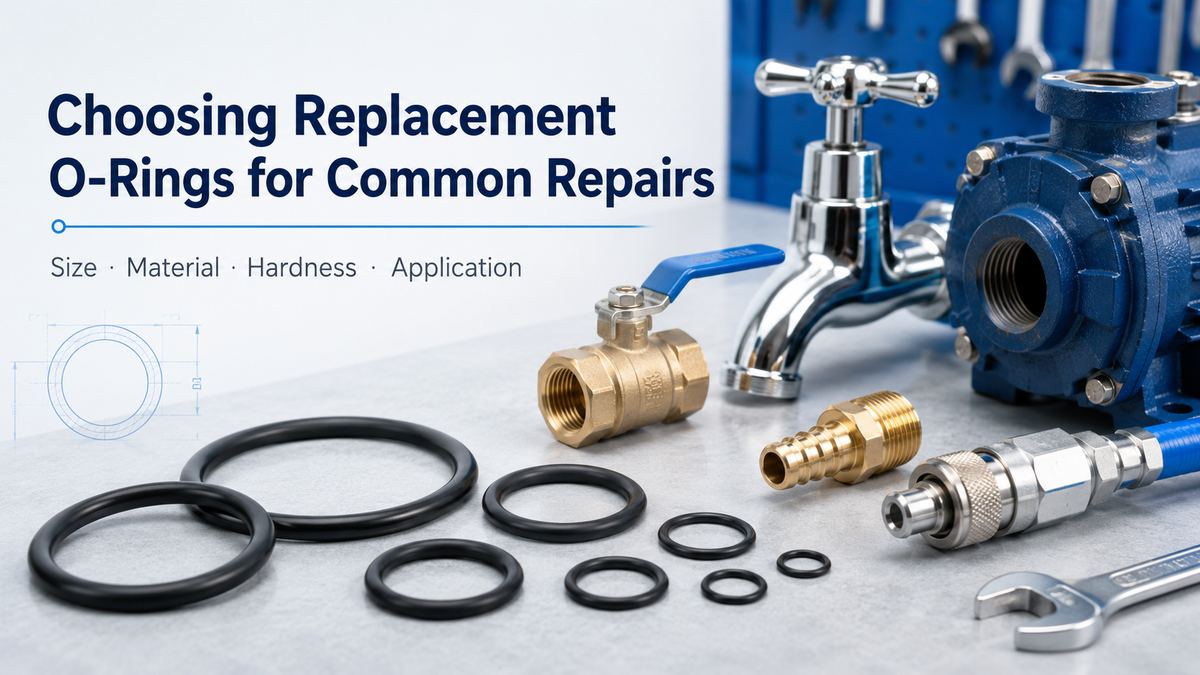
A replacement O-ring should not be selected only because it looks similar to the old seal. The correct choice depends on the original dimensions, groove, exact media, temperature, pressure, movement, hardness, and required documentation.
This guide provides a practical sequence for inspecting the failed seal, measuring it, screening the material, checking the groove, and choosing direct purchase or application review.
Quick replacement checklist
- Identify the equipment and sealing location.
- Record everything that touches the seal during operation and cleaning.
- Inspect the old O-ring for swelling, flattening, cracking, cutting, or twisting.
- Measure the relaxed inner diameter and cross section.
- Check the groove or original part specification when the old seal is deformed.
- Confirm material and hardness.
- Review pressure, clearance, temperature, and static or dynamic motion.
- Clean and inspect the groove before installation.
- Test cautiously before returning the equipment to normal service.
Use How to Measure an O-Ring for the detailed measurement procedure.
1. Inspect the failed O-ring

Swollen or sticky
Swelling, softening, or a sticky surface can indicate a media or compound mismatch. Identify the fluid, cleaner, fuel, oil, solvent, or chemical and review the exact concentration and temperature before selecting the next compound.
Flattened
A ring that remains flat after removal may have compression set. Possible contributors include long service, elevated temperature, excessive squeeze, groove geometry, or an unsuitable compound.
Cracked or hardened
Cracking and hardening can be associated with heat, aging, ozone, outdoor exposure, or chemical attack. Reordering the same material without checking the cause can repeat the failure.
Cut, torn, or nibbled
Inspect for sharp edges, burrs, pinching, pressure extrusion, excessive clearance, or groove damage. A new seal cannot correct a damaged installation path.
Twisted
Twisting can result from rolling during installation, uneven stretching, friction, or motion in service. Check the installation method, lubrication compatibility, and whether the sealing design is suitable for dynamic operation.
2. Identify the actual application
Record the component, fluid or media, cleaning chemicals, minimum and maximum temperature, pressure or vacuum, outdoor exposure, and whether a shaft or piston moves against the seal.
The equipment name alone is not enough. Two pumps or valves can require different compounds because the fluid, temperature, pressure, or motion is different.
3. Measure the size
O-rings are normally identified by:
- ID: inner diameter
- CS: cross section
- OD: outer diameter, approximately ID + 2 × CS

Use a caliper without pulling the ring. Compare the result with the Size Guide, the ID and Cross-Section Guide, and the Metric vs AS568 Guide.
A worn seal may be swollen, stretched, flattened, or missing material. When possible, compare the measurement with the groove, equipment documentation, original part number, or an unused sample.
4. Screen the material
Material-family descriptions are starting points, not proof that every formulation is suitable.

| Material family | Common screening direction | Important limitation |
|---|---|---|
| NBR | Many petroleum oils, grease, air, and general mechanical sealing | Not generally the first choice for ozone, prolonged outdoor exposure, or many strong polar solvents |
| EPDM | Water, weather, ozone, and selected aqueous service | Generally not recommended for petroleum oils or fuels |
| FKM | Many oils, fuels, elevated temperatures, and selected chemicals | Compatibility and low-temperature performance vary by compound |
| Silicone | Low-temperature flexibility and wide-temperature elasticity in selected static applications | Often has lower tear, abrasion, and dynamic-wear resistance |
| FFKM | Demanding chemical or high-temperature service | Exact compound, documentation, availability, and cost require confirmation |
Use the Material Guide and Chemical Compatibility page to narrow the options. Do not identify material by color.
5. Check hardness, pressure, and motion
Hardness affects compression, installation force, extrusion resistance, and sealing behavior. A softer ring is not always better, and a harder ring is not automatically safer.
Review groove design, pressure, clearance, surface finish, temperature, media, and movement. See the O-Ring Hardness Guide for the main trade-offs.

Dynamic service adds friction, wear, and heat. High-pressure service can require tighter clearance, a different hardness, a backup ring, or another seal design. Use the original equipment specification or engineering review where the consequences of failure are significant.
6. Inspect and prepare the groove

- Remove old rubber, dirt, and residue.
- Check corrosion, scratches, burrs, threads, and sharp edges.
- Confirm the groove is not damaged or distorted.
- Install without unnecessary stretching, twisting, or pinching.
- Use lubricant only when it is compatible with the ring and system media.
- Confirm the ring is evenly seated before assembly.
See How to Install an O-Ring and Should You Lubricate an O-Ring? for more detail.
Kit, exact-size pack, or quote?
Kit or assortment: useful for general maintenance or low-risk trial fitting when several common sizes may be needed.
Exact-size small pack: appropriate when ID, cross section, material, hardness, and application are confirmed. Browse small-pack O-rings.
Application review or quotation: use Custom O-Ring Quote for a drawing, sample, custom or unusual size, special compound, documentation requirement, uncertain application, multiple specifications, or a larger purchasing requirement.
Compare the choices in O-Ring Kits vs Exact-Size O-Rings.
Information to prepare
- Equipment or component
- Original part number, if available
- ID and cross section
- Groove width and depth, if available
- Material and hardness, if known
- Exact fluid, chemical, cleaner, or gas
- Temperature and pressure range
- Static or dynamic service
- Quantity and destination country
- Photos, drawing, or sample details
- Required product-specific documentation
Common mistakes
- Guessing the size from appearance
- Trusting a swollen or stretched old ring as the original dimension
- Selecting material by color
- Ignoring the groove or failure cause
- Using an unverified lubricant
- Ordering a large quantity before validating an uncertain replacement
FAQ
Can I use any O-ring that fits the groove?
No. It must also be compatible with the media, temperature, pressure, movement, hardness requirement, and installation conditions.
Why did the replacement swell?
The compound may have absorbed or reacted with the media. Confirm the exact fluid, concentration, temperature, and compound before trying another material.
Why did the replacement flatten?
Possible contributors include compression set, excessive squeeze, elevated temperature, long service, or groove geometry.
When should I request a quote?
Request review when the size or material is uncertain, a drawing or sample is involved, the application is demanding, special documentation is required, or the purchasing requirement is not a simple verified small-pack order.
For the limits of general technical guidance, read the Technical Information, Sources & Review Policy.
Find replacement O-rings by size standard
After checking ID, cross section, material, hardness and service conditions, browse AS568 dash-size O-rings for inch-series fittings or DIN / ISO metric O-rings for metric specifications. Choose the exact nominal dimensions and material rather than assuming that nearby sizes are interchangeable.


