Knowledge Base Size Guide Small Packs

O-Ring Size Chart Guide: How to Match ID and Cross Section

April 28, 2026
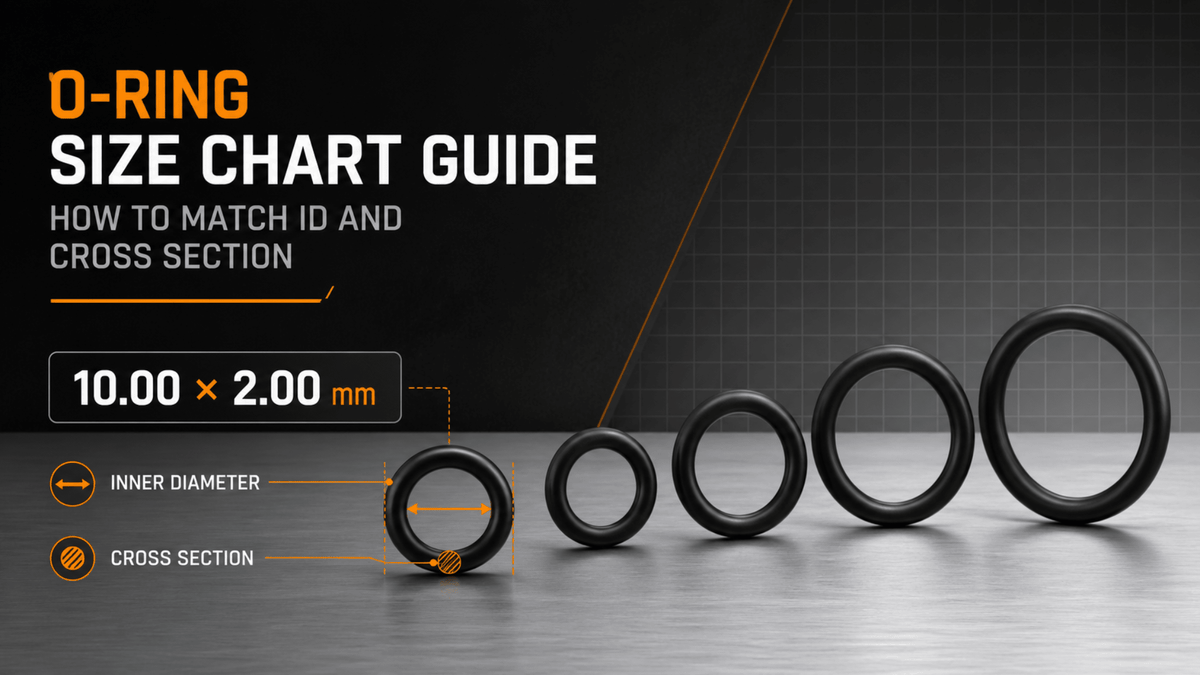
O-ring size chart guide showing ID and cross section measurement examples
Published on  Updated on  

O-Ring Size Chart Guide: How to Match ID and Cross Section

Once you know the size of your old O-ring, the next step is to match it to the right replacement.

For most buyers, the two most important numbers are ID and CS. ID means inner diameter. CS means cross section, or the thickness of the rubber ring.

If you have not measured your O-ring yet, start with our guide on how to measure an O-ring by ID, CS, and OD. If you already know the size, you can search O-ring small packs or use the O-Ring Finder.

How O-ring sizes are usually written

A metric O-ring size is usually written like this:

10.00 × 2.00 mm

This normally means:

10.00 mm inner diameter × 2.00 mm cross section

The first number is the opening inside the ring. The second number is the thickness of the rubber.

This is important because two O-rings can have the same inner diameter but different thicknesses. For example:

10.00 × 1.50 mm
10.00 × 2.00 mm

These are not the same size. The cross section is different, so they may fit and seal differently.

Start with ID and CS, not just OD

Outer diameter can help you check the size, but it should not be the only number you use.

The basic formula is:

OD = ID + (2 × CS)

For example, an O-ring listed as 10.00 × 2.00 mm should have an outer diameter of:

10.00 + (2 × 2.00) = 14.00 mm

Two O-rings can have a similar outside diameter but different ID and CS. That is why ID and CS are usually the better starting point when matching a replacement.

How to use an O-ring size chart

Use this order when checking a size chart or product list:

  1. Match the inner diameter.
  2. Match the cross section.
  3. Check the outer diameter as a final check.
  4. Choose the right material.
  5. Choose the pack size or quote route.

If the size is listed clearly, you can usually move to material selection and pack size. If the size is not listed, or if your measurement is uncertain, use Bulk Quote instead of guessing.

What if your measurement is close but not exact?

This happens often with old O-rings.

If the size is too unclear to match safely, read what to do if you don't know your O-ring size before ordering.

Rubber can stretch, swell, flatten, shrink, or crack after use. Heat, oil, fuel, water, chemicals, pressure, and age can all change the shape of the ring.

If your measured size is close to a listed size, check these points before ordering:

  • Did you measure the O-ring without stretching it?
  • Did you measure the cross section in more than one place?
  • Is the old ring swollen, flat, or damaged?
  • Does the groove or sealing area confirm the same size?
  • Is the application low-risk or high-risk?

For simple repair jobs, a close standard size may be enough. For fuel, pressure, heat, steam, chemicals, or expensive equipment, it is safer to ask before ordering.

Metric sizes and AS568 sizes

Metric O-rings are usually shown directly in millimeters, such as 25.00 × 3.50 mm.

If you are comparing metric sizes with AS568 standard numbers, read our Metric vs AS568 O-Rings Guide.

Some O-rings are listed by AS568 numbers. AS568 is a common inch-based O-ring size standard used in North America.

If you already know the AS568 number, search that number directly. If you only know the size in inches, search the inch size or include both inch and metric measurements when sending a quote request.

If you are not sure whether your part is metric or AS568, do not guess. Send the size, photo, drawing, or application details through Bulk Quote.

Do not ignore the material

Matching the size is only half of the job. The material also needs to fit the application.

NBR is often used for general oil and grease applications. EPDM is often considered for water, weather, and outdoor exposure. FKM is commonly considered for fuel, oil, and higher heat. Silicone may be used where flexibility or cleaner applications matter. FFKM is usually for more demanding chemical or high-temperature conditions.

For a simple overview, read the O-Ring Material Guide. For fuel, oil, chemicals, steam, or unknown fluids, check the Chemical Compatibility Guide before ordering.

A simple buying path

Use this path to decide what to do next:

You know ID, CS, material, and hardness.
Search Shop Small Packs or use the O-Ring Finder.

You know ID and CS, but not the material.
Read the Material Guide first, then search the size.

You know the application, but not the size.
Go back to how to measure an O-ring, then search again.

You need 100+ pcs, a custom size, or a special material.
Use Bulk Quote.

What to include when asking for help

If you send a quote request, include as much of this as possible:

  • Inner diameter
  • Cross section
  • Outer diameter, if measured
  • Metric or inch size
  • AS568 number, if known
  • Material, if known
  • Hardness, if known
  • Application
  • Fluid or chemical exposure
  • Temperature range
  • Quantity needed
  • Photo or drawing, if available

Quick checklist before ordering

  • Confirm the size is ID × CS.
  • Do not choose by OD only.
  • Measure old or damaged O-rings more than once.
  • Check material before buying.
  • Use Bulk Quote for unclear, high-risk, or 100+ pcs orders.

If the size and material are clear, browse O-ring small packs. If the size, material, or application is not clear, send the details through Bulk Quote.

FAQ

Is O-ring size always ID × CS?

For most metric listings, yes. A size like 25.00 × 3.50 mm usually means 25.00 mm inner diameter × 3.50 mm cross section.

Can I use outer diameter to find the size?

You can use outer diameter as a check, but it should not be the only number. ID and cross section are usually more important for choosing the right replacement.

Why does my old O-ring not match the size chart exactly?

Old O-rings can stretch, swell, flatten, or shrink after use. Measure more than once and check the groove if possible.

What is the difference between metric and AS568 O-rings?

Metric sizes are listed directly in millimeters. AS568 sizes use a standard number system commonly used for inch-based O-rings in North America.

What should I do if two sizes look very close?

For low-risk repairs, a close standard size may work. For pressure, fuel, heat, steam, chemicals, or critical equipment, use Bulk Quote before ordering.

Published on  Updated on  

Need help choosing the right O-ring?

Use the next step that matches what you already know: exact size, material, application, or an unclear bulk requirement.

Shop Small Packs Use this when size, material, hardness, and quantity are clear. View products Request Bulk Quote Best for 100+ pcs, drawings, special materials, or unclear conditions. Open quote form Compare Materials Check NBR, EPDM, Silicone, FKM, and FFKM before ordering. Open material guide