
Technical resources
Measure, identify, then review the requirement.
Practical references for maintenance, engineering and purchasing teams working from a drawing or a ring in hand.
These pages explain measurement methods and material families. Confirm the compound and application conditions before choosing a seal.

By task
What do you need to do next?
Measure
Record ID, CS and the original unit from the relaxed ring.
Open the size guideChoose material
Match the family to fluid, temperature and movement.
Compare materialsChoose hardness
Understand Shore A as one compound and design input—not a pressure rating.
Hardness in the material guideDesign & check
Read ID × CS against AS568, ISO 3601 and metric series.
Search standard sizesEngineering checks
Review geometry, motion, tolerance stack, surface condition and service inputs before treating a size or material as suitable.
Open Engineer ProDesign a groove
Separate seal mode, squeeze, stretch, gland fill and clearance before choosing a geometry.
Open the groove toolTroubleshoot failure
Start from visible damage, service history, geometry, motion and media before changing material.
Open the failure diagnosticRequest documents
Ask for paperwork together with the requirement.
Prepare a requestArticles
Latest guides
 Airgun O-Ring Extrusion: How Clearance Gaps Cause Pressure Leaks
Learn how clearance gaps, pressure, hardness, and groove design can cause airgun O-ring extrusion and repea...
Read guide
Airgun Fill Connection O-Rings: A Case Study in Wear and Intermittent Leaks
Learn how repeated insertion, edge damage, debris, and material choice affect airgun fill connection O-ring...
Read guide
 CO2 Airgun O-Rings: Material Selection for Cold and Pressure Cycling
Learn how CO2 cooling and pressure cycling affect airgun O-rings, and compare NBR, FKM, and polyurethane fo...
Read guide
Polyurethane vs NBR O-Rings for Airgun Valves and Fill Connections: A Case Study
Compare polyurethane and NBR O-rings for airgun valves, pressure chambers, and fill connections in a practi...
Read guide
 How to Measure and Identify Replacement O-Rings for Airgun Seals: A Case Study
Learn how a pneumatic equipment supplier identified replacement airgun O-rings by measuring inside diameter...
Read guide
 Airgun O-Ring Sealing Case Study: Solving Pressure Loss and Repeated Leakage
Explore an airgun O-ring sealing case involving pressure loss, repeated leakage, material selection, groove...
Read guide
Method
Measure, identify, review
-
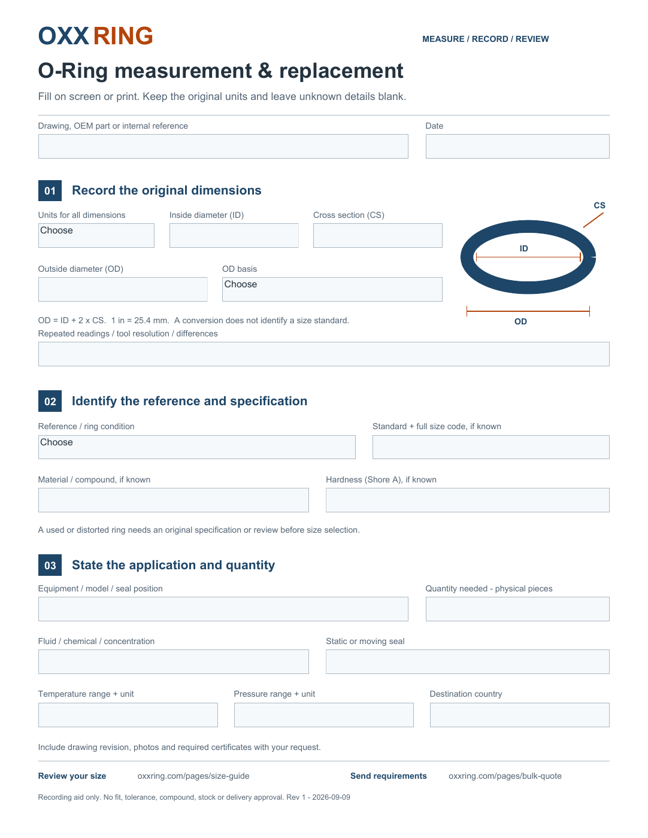 01 · MEASURERecord ID, CS and the original unit.Measure the relaxed ring without stretching it. The worksheet keeps inside diameter, cross section, original units and service notes together.Open the size and measurement guide
-
 02 · IDENTIFYUse the standard when the drawing gives one.AS568 dash numbers are inch based. Keep the recorded units when comparing a standard reference with measured ID × CS.Search AS568 sizes
-
 03 · REVIEWCheck material against the service condition.Compare NBR, FKM, EPDM, Silicone and FFKM by temperature, media and typical use before narrowing the search.Compare material families

Downloads · PDF
Technical library
These references support engineering review and dimensional checks. They are design aids, not product-specific certification or a substitute for the actual hardware and service conditions.
Design charts
- OXX Design RulesGeneral O-ring design review reference.PDF
- OXX Tolerance ChartDimensional tolerance reference.PDF
- Static Gland Design ChartStatic gland geometry reference.PDF
- Dynamic Gland Design ChartDynamic gland geometry reference.PDF
- Face Gland Design ChartAxial / face-seal geometry reference.PDF
- Dovetail Gland Design ChartDovetail gland geometry reference.PDF
Handbooks & checklists
- Engineering Handbook CoreCore O-ring geometry, material and application review reference.PDF
- Standards ReferenceCompact standards and dimensional-reference companion.PDF
- O-Ring Fundamentals GuideShort foundation guide for identification, selection and review.PDF
- Failure Analysis GuideEvidence-first troubleshooting guide for failed O-rings.PDF
- Backup Ring Design GuideReference for backup-ring use and design review.PDF
- Application Design ChecklistChecklist for collecting the operating conditions needed for review.PDF
These PDFs come from the same technical library used across the site; product approval still depends on the exact part, compound and service conditions. Technical Library Index (PDF) · Size chart PDFs · Open compatibility checker
Next step
Ready to order? Start from the common sizes
Most equipment uses standard AS568 or metric sizes. Pick one to see every listed material and hardness, or search your exact ID × CS.
Buyer help
Common questions before you buy
Shipping, returns and payment details live in the store policies; the full buying FAQ is on the FAQ page.
Prepare a requestHow do I find a size?
Use inside diameter (ID), cross section (CS), and the original measurement unit. Add the material and hardness when known. Find O-rings
When will my order ship?
Standard orders usually dispatch in 1–2 business days. Custom parts: with an existing mould usually 3–7 days; with a new mould, tooling and production take 13 days standard or as fast as 7 days rush. Dates are confirmed on the quote; shipping time is additional. Delivery after dispatch depends on the destination and service. Shipping details
Where can I check delivery terms?
Shipping destinations, current rates, delivery estimates and handling notes are maintained in our Shipping Policy. Delivery information
Can I request a custom size or documents?
Send the size, material, hardness, quantity and service conditions with your request. Include any required documents so they can be reviewed with the quotation. Prepare a request
Engineering answers
Questions about materials, service and seal design
Use these answers to identify the operating inputs and choose your next check.
O-Ring Material Selection Guide
Practical guidance for material selection, using operating conditions rather than one-size-fits-all rules.
How do I choose the right O-ring material?
Start with the fluid or chemical, temperature, motion, pressure and gland conditions. A material family can be a useful starting point, but the exact compound and application conditions still need validation.
Do not present family-level guidance as final compound approval.
Enter the operating medium and conditions to screen candidate material families.
Can I use the same O-ring material for static and dynamic sealing?
Not automatically. Dynamic seals add friction, wear, lubrication, speed and surface-finish requirements that can change the best material or compound choice even when chemical compatibility looks acceptable.
Chemical compatibility alone is not dynamic-service approval.
Provide speed or cycle rate, lubrication, surface condition and gland geometry for dynamic review.
Why does operating temperature matter when choosing an O-ring?
Temperature changes elastomer stiffness, compression behavior, fluid interaction and usable service margin. A temperature range for one compound or test condition should not be treated as a universal limit for every compound in the same material family.
Do not convert family or test temperatures into universal continuous-service limits.
Add normal and peak operating temperature to the material review.
Why can two compounds from the same elastomer family behave differently?
Compounds within the same elastomer family can use different formulations, hardness levels and additives. That is why a family-level compatibility rating can disagree with a specific compound test and why exact compound review matters for critical service.
Do not average conflicting family-level and compound-level evidence.
Use family screening first, then validate the exact compound for the application.
How much O-ring swelling is acceptable?
There is no single percentage that is safe for every application. Dynamic seals are usually more sensitive to swelling because friction, wear and toughness can change, while static seals may tolerate more depending on gland fill and assembly conditions.
Keep service guidance separate from qualification-test limits.
Review swelling together with motion, gland fill and the exact compound test context.
O-Ring Pressure, Gland & Backup Ring Guide
Practical guidance for pressure and gland design, using operating conditions rather than one-size-fits-all rules.
If a material is chemically compatible, is it automatically suitable for high pressure?
No. Chemical compatibility does not establish pressure capability. High-pressure sealing also depends on extrusion clearance, hardness, gland geometry, pressure direction and whether a backup ring is needed.
Never infer a pressure rating from compatibility evidence.
Provide pressure, clearance, hardness and gland details for extrusion review.
When does an O-ring need a backup ring?
Backup-ring need is driven by the combination of pressure, extrusion clearance, O-ring hardness, temperature and pressure direction. The correct number and location of backup rings also depends on whether pressure is one-way or can reverse.
Do not use a single pressure threshold as a universal rule.
Submit pressure direction, clearance and hardness for a backup-ring check.
Is a smoother sealing surface always better?
No. Dynamic seals need a surface that is smooth enough to limit wear but still able to retain a lubricating film. An extremely polished surface can reduce lubricant retention and increase friction in some dynamic applications.
Surface-finish units and metrics must not be converted without a verified method.
Include surface finish and lubrication condition in dynamic seal review.
O-Ring Vacuum & Gas Sealing Guide
Practical guidance for vacuum and gas sealing, using operating conditions rather than one-size-fits-all rules.
What changes when an O-ring is used in vacuum or gas service?
Vacuum and gas sealing add permeability, surface leakage and outgassing concerns that are less important in many liquid applications. Squeeze, surface condition, compound permeability and lubrication can all change leak behavior.
Do not turn reference leak calculations into pass/fail approval.
Provide gas or vacuum conditions, temperature, seal type and cleanliness requirements.
What is explosive decompression in an O-ring?
Gas can dissolve into an elastomer under pressure and then expand during rapid depressurization, creating blisters, pits, fissures or rupture. Risk depends on gas, pressure, compound, cross section, temperature, soak time and decompression rate.
Do not use one pressure threshold as a universal safe limit.
Provide gas type, maximum pressure and depressurization profile for review.
O-Ring Failure Diagnosis & RFQ Guide
Practical guidance for failure diagnosis and rfq, using operating conditions rather than one-size-fits-all rules.
Can O-ring damage be diagnosed from a photo alone?
A photo can help rank likely failure modes, but appearance alone is not enough to prove a single root cause. Pressure history, motion, temperature, media, lubrication, installation and gland condition are often needed to separate similar-looking failures.
Never present image-only diagnosis as a confirmed root cause.
Use the visible damage as a starting point and collect the service history before deciding the root cause.
What information should I provide for an O-ring material recommendation or RFQ?
At minimum, provide the sealing medium and whether the application is static or dynamic. Temperature, pressure, size, quantity and—when relevant—speed, lubrication, surface finish, extrusion clearance, hardness and gland details make the review much more reliable.
RFQ readiness does not equal service approval, stock confirmation or lead-time commitment.
Submit the operating conditions, size and quantity for engineering review and quotation.
Engineering reference
Rules of thumb and checks for a reliable seal
The design rules and checks we use when reviewing a size, material or groove. They are starting points: confirm them against your actual pressure, temperature, fluid and motion.
Standards and materials
- AS568
- The inch-based standard (current revision AS568F) that defines O-ring inside diameter, cross-section, tolerances and dash numbers. The dimensions apply to any elastomer that can be moulded to them, and include straight-thread tube-fitting boss gaskets (the -9xx dash numbers). AS568 size chart
- Compound, not just material
- An O-ring compound is a base elastomer plus curing agents, fillers and plasticizers. The recipe changes heat, chemical and wear behaviour, so two NBR or two FKM compounds can perform differently. Compare the data for the exact compound against your application.
Gland design rules of thumb
For static and reciprocating (non-rotating) O-rings in oil, hydraulic fluid or other normal lubricants, with controlled machining tolerances.
- Gland fill
- Keep the O-ring cross-section at or below about 90% of the groove's cross-section area, leaving room for heat expansion and fluid swell. Above 100% the ring has nowhere to go: redesign the groove rather than force the fit.
- Installed stretch
- Keep stretch to about 3% when the ring is stretched into its groove. If the nearest standard size needs more, a different or custom size is usually better than overstretching.
- Extrusion gap
- The clearance a seal can bridge depends on system pressure and O-ring hardness. If the gap is too large for the pressure, tighten the tolerance, choose a harder compound or add a backup ring.
- Face seals
- Seat the ring against the groove wall on the side away from the pressure: the outer wall when pressure is inside, the inner wall when it is outside. Pressure then cannot push the ring across the groove.
- When these rules don't apply
- High pressure, wide tolerances, very low friction targets or other fluids need the seal and groove design confirmed by test or engineering analysis.
Check before production
Review each point for the actual installation and service conditions.
- Gland geometryGroove depth, width and fill for this installation
- Compression setSqueeze the ring won't recover after long periods under load; depends on compound, temperature and time
- Extrusion and nibblingAt high pressure; consider a backup ring
- Chemical compatibilityWith every fluid, cleaner and lubricant the seal touches
- Service temperatureNormal and peak
- AbrasionIn moving (dynamic) applications
- Surface finishOf the sealing faces and the groove
- Lubrication and frictionAt assembly and in service
- SwellingFrom chemical exposure; recheck gland fill
- HardnessAgainst pressure, extrusion gap and service conditions
Then test the chosen compound and seal design in the real installation before production use.
Silicone in harsh environments: what tests show
Findings from published tests on specific silicone compounds. They show what to check, not ratings for silicone in general.
- UV and atomic oxygen
- In tests on three silicone compounds for a spacecraft docking seal, atomic oxygen raised leakage modestly; atomic oxygen plus UV raised it by up to 600 times and reduced seal adhesion. If a silicone seal will see UV, plasma or space-like conditions, test the exact compound.
- Outgassing
- The compounds in that study measured below 1.0% total mass loss and below 0.1% collected volatile condensable material (ASTM E595). For vacuum, optics or semiconductor equipment, ask for E595 data on the exact compound: it is not a property of silicone in general.
- Dust and debris
- In tests with a lunar-dust simulant, debris on silicone face seals greatly increased leakage unless the seal was fully closed; cleaning the seal generally brought leakage back to the as-new level. Keep sealing faces clean at assembly and protect face seals from grit.