
Knowledge · Bulk Quote
O-Ring Kits vs Exact Size O-Rings: Which Should You Buy?
Compare O-ring kits with exact-size small packs and choose the correct path for general maintenance, a confirmed replacement, or an application that needs review.
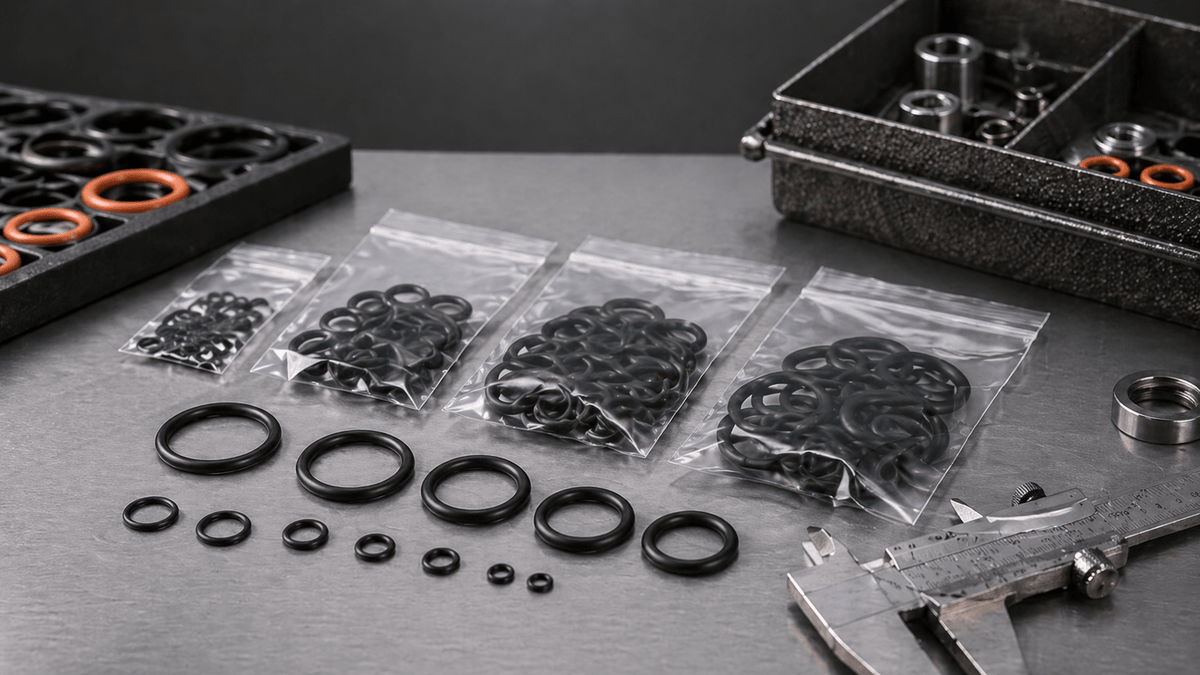
An O-ring kit and an exact-size small pack solve different problems. A kit provides a range of possible sizes for general maintenance or low-risk test fitting. An exact-size pack is the better choice when the dimensions, material, hardness, and application are already known.
Quick answer
Choose a kit when you need an assortment and do not know which common size will be required before opening the equipment. Choose exact-size O-rings when the specification is known. Use Custom O-Ring Quote when a drawing, sample, unusual size, special compound, application review, or larger purchasing requirement needs confirmation.
What is an O-ring kit?
A kit contains selected O-rings in multiple sizes. Kits may be organized by metric dimensions, AS568 inch sizes, material, or general repair use. They are convenient for workshops and maintenance tasks, but they do not contain every size, material, or hardness.
What is an exact-size O-ring?
Exact-size O-rings are ordered by a specific inner diameter and cross section, normally written as ID × CS. For example, 10.00 × 2.00 mm means a 10.00 mm inner diameter and 2.00 mm cross section.
Use How to Measure an O-Ring before matching a worn seal. A stretched, swollen, or flattened ring may no longer represent its original size.
When a kit is useful
- You maintain different low-risk equipment
- The size is not known before disassembly
- You need nearby sizes for trial fitting
- You want common sizes available for general workshop work
- The fluid, pressure, and consequences of failure are limited
A trial fit does not confirm material compatibility or long-term sealing performance.
When exact-size packs are better
- ID and cross section are confirmed
- Material and hardness are known
- The same repair is repeated
- You want consistent maintenance stock
- The application has defined fluid, temperature, pressure, or movement
Exact-size ordering reduces unused assortment sizes and makes repeat maintenance more consistent.
Why size and material both matter
A nearby size can still leak, pinch, stretch, or fail to compress correctly. The correct dimensions must also use a suitable compound for the actual media and operating conditions.
- NBR: common starting point for many oils, grease, and general mechanical service.
- FKM: considered for many oils, fuels, elevated temperatures, and selected chemicals.
- EPDM: considered for water, weather, ozone, and selected aqueous service.
- Silicone: considered where flexibility across temperature changes matters, with wear limitations to review.
- FFKM: considered for demanding service after exact compound and documentation review.
Use the Material Guide, Chemical Compatibility, and Hardness Guide before buying.
Kit vs exact-size comparison
| Question | Kit | Exact-size pack |
|---|---|---|
| Best use | General maintenance and low-risk trial fitting | Known replacement specification |
| Size confidence | Depends on matching from the assortment | Higher when measured and confirmed |
| Material confidence | Limited to the kit compound | Selected for the application |
| Unused pieces | Often includes sizes not needed | Focused on one specification |
| Repeat maintenance | Less consistent | Easier to standardize |
Do not guess from a kit when
- Fuel, chemicals, steam, high temperature, or aggressive cleaning is involved
- The seal operates under meaningful pressure or dynamic movement
- A product-specific certification or document is required
- Failure could damage equipment or create a safety problem
- The groove or original size is uncertain
Simple decision path
Need a general assortment: a kit may be useful.
Know the exact size and material: browse exact-size small packs.
Need help with a sample, drawing, compound, unusual size, or purchasing requirement: use Custom O-Ring Quote.
FAQ
Does a kit include every O-ring size?
No. It contains a selected range and might not include the exact size, compound, or hardness required.
Can a kit identify the correct size?
It can help with low-risk trial fitting, but measurement and groove verification are more reliable.
What should I do with only an old sample?
Measure ID and cross section, document the application, and submit photos or a drawing when deformation makes the original dimensions uncertain.
For the limits of general technical guidance, see the Technical Information, Sources & Review Policy.


