
Knowledge · Bulk Quote
How to Choose O-Rings for Pressure Washer Quick-Connect Leaks
Diagnose a pressure washer quick-connect leak, inspect and measure the O-ring, review material and hardness, and choose an exact-size pack or application review.
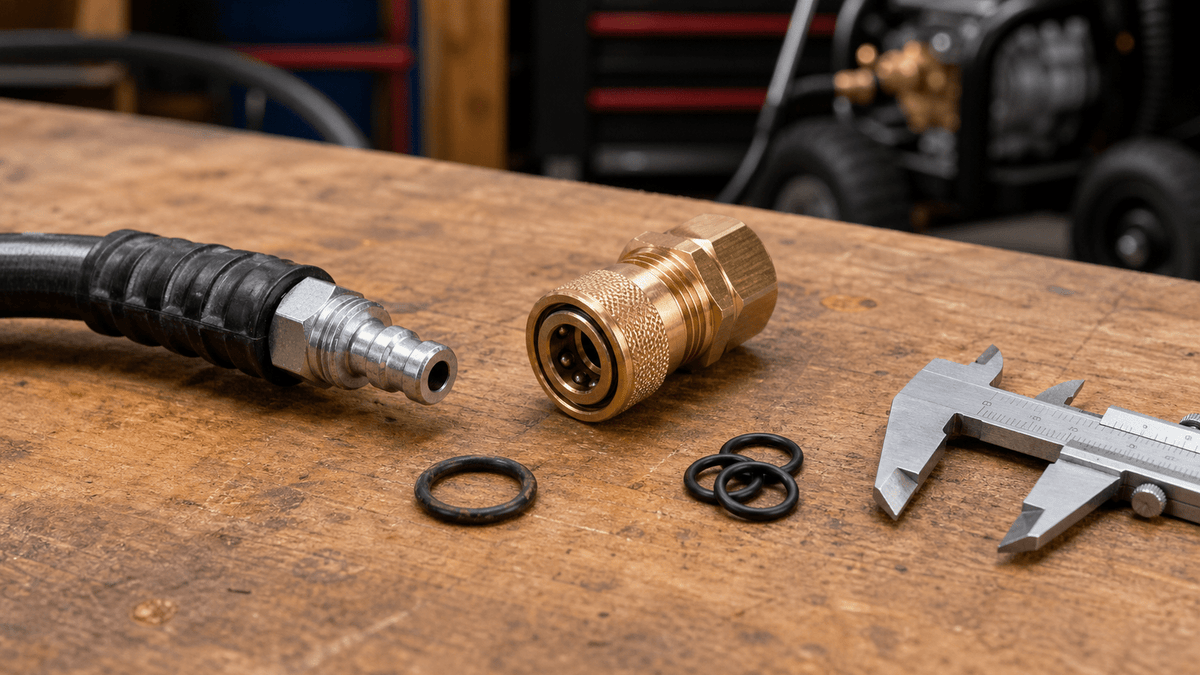
A pressure washer quick-connect leak is often caused by a damaged, missing, incorrectly sized, or unsuitable O-ring. Do not select a replacement only by color or appearance. Confirm the sealing location, inner diameter, cross section, material, hardness, and actual operating conditions.
Quick answer
Disconnect and depressurize the equipment, inspect the connector and old seal, measure the relaxed O-ring by inner diameter and cross section, and check the groove for damage. Use a verified exact-size small pack when the specification is known. Use the Custom O-Ring Quote route when the old ring is badly deformed, the size or material is uncertain, a sample or drawing needs review, or the requirement is unusual.

1. Confirm where the leak begins
Dry the connection, reconnect it, and observe where water first appears. A leak at the quick-connect interface can involve the O-ring, but it can also result from a scratched fitting, damaged groove, loose connection, cracked component, dirt, or an incompatible mating part.
Do not continue testing a damaged high-pressure connection. Follow the equipment manufacturer's shutdown and service instructions.
2. Inspect the connector and old seal

- Flattened: possible compression set, long service, heat, excessive squeeze, or groove issues.
- Swollen or soft: possible media, cleaner, lubricant, or compound mismatch.
- Cut or torn: possible sharp edge, burr, pinching, or installation damage.
- Extruded or nibbled: possible clearance, pressure, hardness, or groove-design issue.
- Missing: do not guess the size from the empty groove without measurement or a reliable specification.
Clean the groove and inspect it for corrosion, scratches, burrs, and embedded debris. A new O-ring will not correct a damaged sealing surface.
3. Measure before ordering

O-rings are normally identified by ID × CS: inner diameter × cross section. Use a caliper without stretching the ring. A worn seal may be swollen, flattened, stretched, or missing material, so compare the result with the groove, original part specification, or an unused sample when possible.
Follow How to Measure an O-Ring and compare the result with the Size Guide.
4. Screen the material and hardness
Water exposure alone does not determine the correct compound. Also consider detergent or cleaner exposure, storage environment, temperature, pressure, movement, lubricant, and the original equipment requirement.
- NBR: commonly used in many general mechanical applications, but long-term weather and ozone exposure should be reviewed.
- EPDM: commonly considered for water, weather, ozone, and selected aqueous service; it is generally not the first choice for petroleum oils or fuels.
- FKM: considered when oils, fuels, elevated temperature, or selected chemicals are involved, subject to exact compound compatibility.
- Other compounds: should be selected from the exact application and documentation rather than from color.
Hardness affects installation, compression, extrusion resistance, and sealing behavior. Do not replace a harder ring with a softer one, or the reverse, without checking the original specification and groove conditions.
Use the Material Guide, Chemical Compatibility, and Hardness Guide to narrow the options.
5. Install without creating a new failure
- Depressurize and disconnect the equipment.
- Remove the old seal without scratching the groove.
- Clean and inspect the groove and fitting.
- Use only a lubricant that is compatible with the ring and system, when lubrication is appropriate.
- Install the ring without twisting, cutting, pinching, or unnecessary stretching.
- Confirm the ring is evenly seated.
- Reconnect and test cautiously at low pressure before normal operation.
See How to Install an O-Ring for the detailed procedure.
Choose the buying path
Verified size, material, and hardness: browse exact-size small packs.
Uncertain size, badly worn sample, special compound, drawing, multiple specifications, or unusual purchasing requirement: use Custom O-Ring Quote and include measurements, photos, equipment details, media, temperature, pressure, quantity, and destination country.
FAQ
Can I identify the correct pressure washer O-ring by color?
No. Color is not reliable proof of material, hardness, or size.
Can I use a nearby size from an assortment?
A nearby size may appear to fit but can leak, pinch, stretch, or compress incorrectly. Measure and verify the specification whenever possible.
Why does the new O-ring still leak?
Possible causes include the wrong size, unsuitable compound or hardness, a damaged groove or fitting, installation damage, debris, or a problem elsewhere in the connection.
When should the connector itself be replaced?
Replace or service the component according to the equipment manufacturer's instructions when the groove, fitting, thread, locking mechanism, or sealing surface is cracked, corroded, deformed, or otherwise damaged.
This article provides general screening and purchasing guidance. It does not confirm compatibility with a specific pressure washer brand or model. See the Technical Information, Sources & Review Policy.


