
Knowledge · Bulk Quote
Can One O-Ring Material Work for Oil, Water, Heat, and Chemicals?
Learn why no single O-ring material covers oil, water, heat, fuel, chemicals, and every environment, and how to select from the actual application.
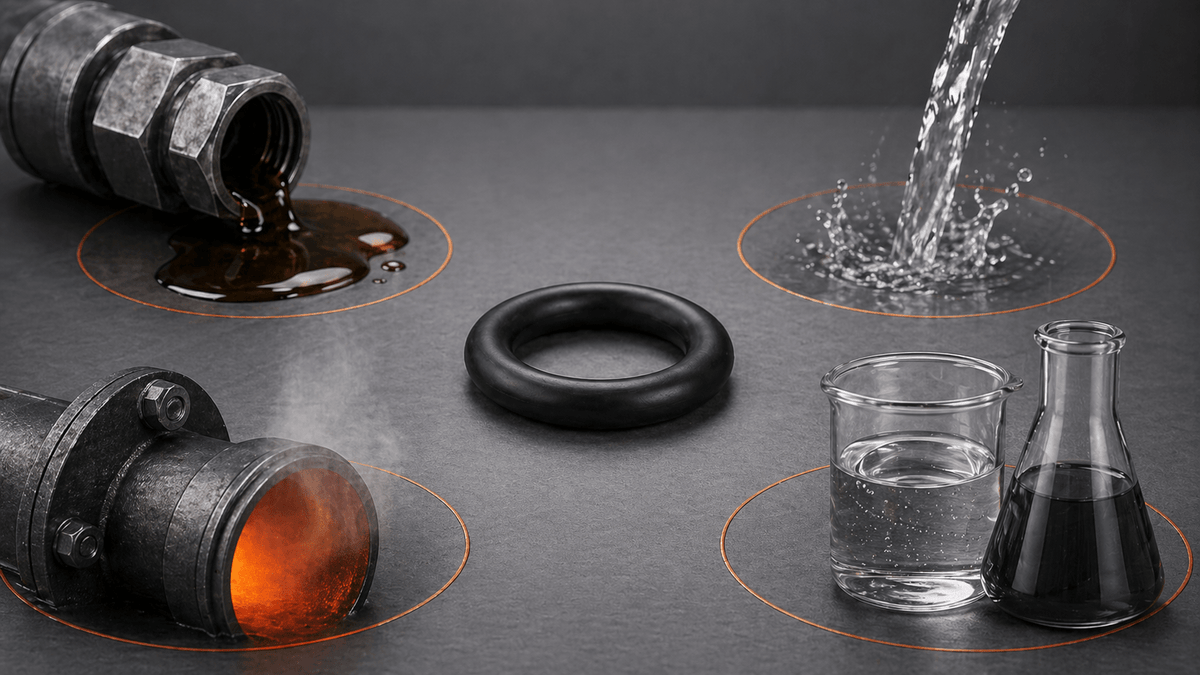
There is no single O-ring material that is the best choice for oil, water, heat, fuel, chemicals, outdoor exposure, and every repair application. Material selection must start with the exact media and operating conditions.
Quick answer
NBR, FKM, EPDM, silicone, FFKM, and other elastomer families each have useful strengths and important limitations. Choose from the application backward: fluid or chemical, concentration, temperature, pressure, exposure time, static or dynamic motion, groove, hardness, and required documentation.
When size, material, hardness, and application are already confirmed, browse exact-size small packs. When the media, compound, sample, drawing, or operating conditions need review, use Custom O-Ring Quote.
Why one material cannot cover every condition
Elastomer families have different resistance, flexibility, wear, and temperature characteristics. A compound that performs well in one petroleum oil may not suit a water-based cleaner. A compound selected for outdoor weathering may be unsuitable for fuel. Higher temperature can also change the compatibility result.
Color, price, or the phrase “strongest material” does not prove suitability.
Material families as starting points
| Material family | Common screening direction | Important limitation |
|---|---|---|
| NBR | Many petroleum oils, grease, compressed air, and general mechanical sealing | Fuel compatibility varies by compound; ozone, prolonged outdoor exposure, high heat, and many solvents require review |
| FKM | Many oils, fuels, elevated temperatures, and selected chemicals | Compatibility and low-temperature performance vary by grade and compound |
| EPDM | Water, moisture, ozone, weather, and selected aqueous service | Generally not the first choice for petroleum oils or fuels; steam suitability is compound- and condition-specific |
| Silicone | Low-temperature flexibility and wide-temperature elasticity in selected static service | Often lower tear, abrasion, and dynamic-wear resistance |
| FFKM | Demanding chemical or high-temperature service | Exact grade, media, documentation, availability, and cost must be confirmed |
This table narrows the candidates; it does not confirm a specific OXXRing product for an application.
Oil, grease, and hydraulic service
NBR is often a practical starting point for many petroleum oils and general mechanical applications. However, hydraulic fluids, fuel-contaminated oils, additives, fire-resistant fluids, and elevated temperatures can change the decision.
See O-Ring Materials for Fuel, Oil, and Hydraulic Systems.
Water, weather, and steam-related service
EPDM is often screened first for water, ozone, outdoor weathering, and selected aqueous environments. Hot water and steam require the exact compound, temperature, pressure, exposure cycle, and system chemistry to be reviewed.
See EPDM vs Silicone O-Rings and O-Rings for Water Pumps, Plumbing, and Outdoor Equipment.
Fuel, chemicals, and elevated temperature
FKM is commonly considered for many oils, fuels, elevated temperatures, and selected chemicals. FFKM may be considered when service is more demanding. Neither family should be selected without checking the exact media, concentration, temperature, exposure time, pressure, and grade.
Use Chemical Compatibility: How to Read Resistance and High-Temperature O-Rings.
Do not choose by color or price
Black, red, orange, white, clear, or another color does not reliably identify the material, hardness, formulation, or certification. The most expensive compound is also not automatically the correct choice.
Information needed before selection
- ID and cross section
- Material and hardness, if known
- Exact fluid, chemical, cleaner, gas, or mixture
- Concentration and exposure time
- Minimum and maximum temperature
- Pressure or vacuum
- Static, reciprocating, rotating, or other motion
- Groove or equipment specification
- Quantity, destination, drawing, sample, and required documentation
Choose the buying path
Verified specification: use small packs.
Unclear media, compound, size, documentation, drawing, sample, or unusual requirement: use Custom O-Ring Quote.
FAQ
Is there a universal O-ring material?
No. The correct compound depends on the complete application.
Can FKM replace every other material?
No. FKM is useful in many demanding applications, but it is not universally compatible or automatically the most economical choice.
Can EPDM be used with oil or fuel?
EPDM is generally not the first choice for petroleum oils or fuels. Confirm the exact media and compound.
What should I do when the existing material is unknown?
Document the fluid, temperature, pressure, motion, size, failure condition, and equipment information, then submit the available details for review rather than choosing by appearance.
For the limits of general material guidance, read the Technical Information, Sources & Review Policy.


