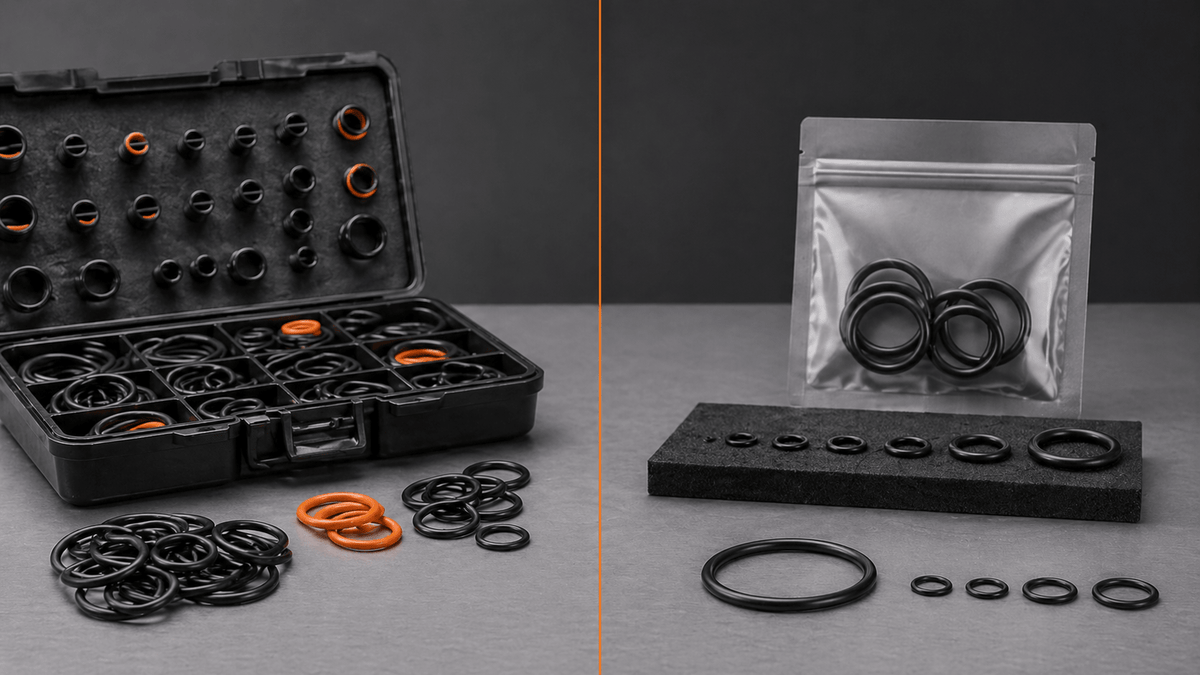
O-Ring FAQ for Small Pack Buyers
Buying a small pack of O-rings should be simple, but many buyers still have the same questions before ordering: What size do I need? Which material should I choose? Does hardness matter? Should I buy small packs or request a quote?
This FAQ is written for small-pack buyers, repair users, DIY users, and maintenance teams who need a practical replacement O-ring without getting lost in overly complex engineering terms.
If you already know the size, material, and hardness, you can browse O-ring small packs. If the size, material, fluid, or quantity is unclear, use Bulk Quote and include a photo, drawing, or sample details.
1. What does O-ring size mean?
Most O-ring sizes are written as:
ID × CS
ID means inner diameter. CS means cross section, or the thickness of the rubber ring.
For example, an O-ring listed as 10.00 × 2.00 mm has a 10.00 mm inner diameter and a 2.00 mm cross section.
If you are not sure how to measure these, start with How to Measure an O-Ring: ID, CS, and OD Explained.
2. Can I measure the old O-ring?
Yes, but be careful. Old O-rings may be stretched, flattened, swollen, cracked, or hardened after use. That means the old ring may not measure exactly like the original part.
Measure in more than one place if possible. If the O-ring is badly damaged, also check the groove, old part number, equipment manual, or drawing if available.
If the old ring is damaged and the size is unclear, read What to Do If You Don't Know Your O-Ring Size.
3. What material should I choose?
The right material depends on what the O-ring touches and where it is used.
As a simple starting point:
- NBR is often used for oil, grease, and general repair work.
- FKM is often considered for fuel, higher heat, and stronger chemical exposure.
- EPDM is often used for water, weather, outdoor exposure, and some steam-related conditions.
- Silicone is often used when flexibility or temperature range matters.
- FFKM is used for more demanding chemical or high-temperature conditions.
For material comparison, read Material Guide, NBR vs FKM O-Rings, and EPDM vs Silicone O-Rings.
4. Does hardness matter?
Yes, hardness can matter. O-ring hardness is usually shown as a Shore A number, such as 60A, 70A, 75A, 80A, or 90A.
70A is a common general-purpose hardness, but it is not correct for every job. Softer O-rings may be more flexible. Harder O-rings may be used where pressure, extrusion resistance, or firmer sealing is needed.
For a simple explanation, read O-Ring Hardness Explained.
5. Can I choose by color?
No. Color is not a reliable way to confirm O-ring material.
A black O-ring may be NBR, FKM, EPDM, or another material. A colored O-ring may suggest a material family, but it does not prove the exact compound, hardness, or compatibility.
If the material matters, check the old part specification, drawing, manual, or supplier information when possible.
6. Can one O-ring material work for everything?
Usually no. One material is not best for oil, water, heat, fuel, chemicals, and outdoor exposure at the same time.
A material that works well in oil may not work well in hot water. A material that handles weather may not be right for fuel. A material that handles heat may still fail with the wrong chemical.
For more detail, read Can One O-Ring Material Work for Oil, Water, Heat, and Chemicals?.
7. What if my O-ring is leaking?
A leaking O-ring may be the wrong size, wrong material, damaged during installation, or used with the wrong fluid or temperature. The groove or sealing surface may also be damaged.
Before replacing it, check the old O-ring, groove, mating surface, fluid, temperature, and installation condition.
For a troubleshooting checklist, read Why Is My O-Ring Leaking?.
8. Should I lubricate an O-ring before installation?
Sometimes lubrication can help installation, but it must be compatible with the O-ring material and the working fluid.
Do not use random oil, grease, or chemicals unless you know they are safe for the material and application. The wrong lubricant may cause swelling, softening, cracking, or early failure.
For more detail, read Should You Lubricate an O-Ring?.
9. How do I avoid damaging an O-ring during installation?
Make sure the groove is clean, the sealing surface is smooth, and the O-ring is seated evenly. Avoid twisting, cutting, stretching too much, or dragging the ring over sharp threads.
If the part does not close smoothly, stop and check the O-ring again instead of forcing the assembly.
For installation basics, read How to Install an O-Ring Without Twisting, Cutting, or Pinching It.
10. When should I buy small packs?
Small packs are a good choice when the replacement is clear and the risk is low.
Buy small packs when you know:
- The size
- The material
- The hardness, if required
- The quantity you need
- The application is not unclear or high-risk
If these details are clear, browse O-ring small packs.
11. When should I use Bulk Quote?
Use Bulk Quote when the order is not a simple small-pack replacement.
Bulk Quote is better when:
- You need 100+ pcs
- The size is not listed
- The material is unclear
- The fluid or chemical is unclear
- The temperature or pressure is important
- You have a drawing, sample, or photo
- You need a custom size, special material, or special hardness
If you are not sure, it is better to ask before ordering the wrong O-ring.
12. What information should I send if I need help?
Send as much useful information as possible. You do not need every detail, but more information helps avoid wrong-size and wrong-material choices.
- Inner diameter and cross section
- Outer diameter, if measured
- Material, if known
- Hardness, if known
- Fluid or media
- Temperature range
- Pressure or movement, if known
- Quantity needed
- Photo, drawing, sample, or part number
13. Can I order if I only know the outer diameter?
Outer diameter can help, but most O-ring listings are based on inner diameter and cross section.
If you only know OD, you may still need to calculate or measure ID and CS. The basic formula is:
OD = ID + 2 × CS
If you need help matching a size, read the O-Ring Size Chart Guide.
14. Are small packs suitable for business buyers?
Yes, small packs can be useful for samples, testing, repair, maintenance, and low-volume needs.
For repeat use, production needs, special requirements, or 100+ pcs, Bulk Quote is usually the better path.
15. What should I do next?
If you know the size, material, and hardness, go to Shop Small Packs.
If you need help with material, start with the Material Guide.
If the fluid or chemical matters, check Chemical Compatibility.
If you need 100+ pcs, a custom size, a drawing review, or help choosing, use Bulk Quote.
FAQ
What is the fastest way to find the right O-ring?
Start with size: ID and CS. Then choose material and hardness based on the fluid, temperature, and application.
Can I buy small packs if I am not sure about the material?
It is better to confirm material first. If the material or fluid is unclear, use Bulk Quote before ordering.
Do I need hardness for every order?
Not always, but hardness matters in many sealing applications. If your old part or drawing specifies hardness, match it when possible.
Why are there so many O-ring sizes?
O-rings are used in many grooves, fittings, pumps, valves, connectors, and equipment designs. Small size differences can affect sealing performance.
Can OxxRing help if I have a sample or drawing?
Yes. Use Bulk Quote and include a photo, drawing, sample dimensions, material details, and quantity needed.
Next step: Browse O-ring small packs if your specification is clear, or use Bulk Quote if you need help choosing.