Knowledge Base Material Guide Bulk Quote

When to Use FFKM O-Rings Instead of FKM

April 28, 2026
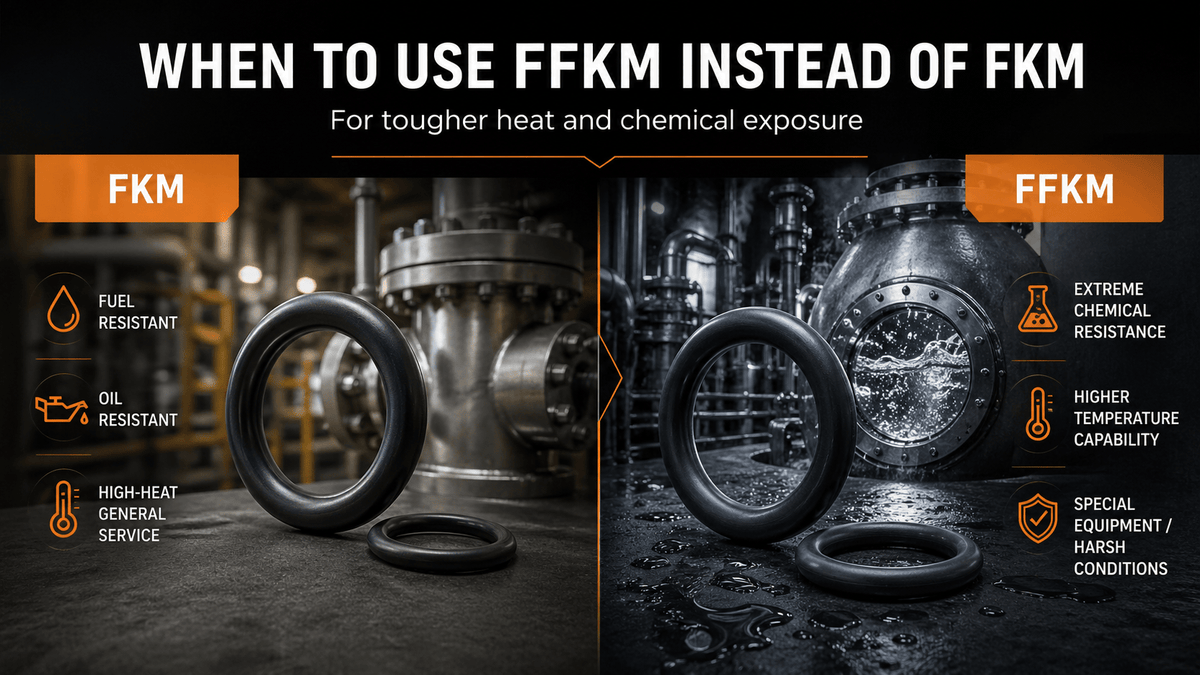
Alt text: FKM versus FFKM O-rings comparison for tougher heat chemical exposure and critical service
Published on  Updated on  

When to Use FFKM O-Rings Instead of FKM

FKM is already a strong O-ring material for many fuel, oil, heat, and chemical-related jobs. But some applications need even more chemical or temperature resistance. That is where FFKM may be considered.

FFKM O-rings are usually not the first choice for everyday repair work. They are more often used when the application is demanding, the cost of failure is high, or FKM may not be enough.

If you already know the exact size and material, you can search O-ring small packs. If you are comparing FKM and FFKM for chemicals, high temperature, special equipment, or 100+ pcs, use Bulk Quote before ordering.

Quick answer

Choose FKM for many fuel, oil, heat, and general chemical-resistance needs where the conditions are known and not extreme.

Consider FFKM when the application involves more demanding chemicals, higher heat, special equipment, or a high cost of failure.

If you are not sure whether FKM is enough, do not guess. Check the Chemical Compatibility Guide or send the details through Bulk Quote.

What is FKM?

FKM is a fluoroelastomer material often used for fuel, oil, higher heat, and more demanding sealing jobs than general-purpose rubber.

Many buyers also know FKM by the common trade name Viton. In many small-pack buying situations, FKM is the material to check when NBR may not be strong enough for fuel or heat.

For a simple comparison, read NBR vs FKM O-Rings.

What is FFKM?

FFKM is a perfluoroelastomer material. It is usually considered for more demanding sealing conditions than FKM.

FFKM may be used where chemical exposure, high temperature, or process risk makes standard materials unsuitable. It is usually more expensive than FKM, so it should be chosen for the right reason, not just because it sounds stronger.

If your application has aggressive chemicals, high heat, clean process requirements, or expensive downtime risk, FFKM may be worth reviewing.

FKM vs FFKM comparison

Question FKM FFKM
Common use Fuel, oil, heat, many demanding repairs Special chemical, high heat, or high-risk service
Cost Higher than general rubber Usually much higher than FKM
Best for Known fuel, oil, and heat applications Demanding or unclear chemical conditions
Buying route Small packs may work when size and spec are clear Often better handled through quote if conditions are unclear

When FKM is usually enough

FKM may be enough when the application is known and the working conditions are within normal FKM expectations.

Common examples include:

  • Fuel-related repair where FKM is specified
  • Oil plus heat exposure
  • Engine-area sealing
  • General higher-temperature repair
  • Applications where the old part or drawing already calls for FKM

If the size, material, hardness, and fluid exposure are clear, FKM small packs may be the faster route.

For normal fuel, oil, and hydraulic applications, review which O-ring material fits fuel, oil, and hydraulic systems before moving to FFKM.

When FFKM may be worth checking

FFKM may be worth checking when the application is more demanding than a normal repair job.

Examples include:

  • Aggressive or unclear chemical exposure
  • High temperature service
  • Process equipment where downtime is expensive
  • Special equipment or non-standard sealing conditions
  • Applications where FKM has failed or is not approved

In these cases, it is better to review the requirement before buying. FFKM is not a material to choose casually.

Do not use FFKM just because it is stronger

FFKM can be a high-performance material, but that does not mean it is the right choice for every job.

For many normal fuel, oil, and heat applications, FKM may already be suitable. For general oil or grease, NBR may even be the more practical starting point.

Before choosing FFKM, check the actual need:

  • What fluid or chemical is touching the O-ring?
  • What is the working temperature?
  • Is the seal static or moving?
  • What size and hardness are required?
  • How many pieces do you need?
  • Is there a drawing, compound requirement, or approval note?

Small packs or Bulk Quote?

Use Shop Small Packs only when the size, material, hardness, and quantity are clear.

Use Bulk Quote when:

  • You need 100+ pcs.
  • The size is not listed.
  • The material requirement is FFKM or unclear.
  • The application involves aggressive chemicals or high heat.
  • You have a drawing, sample, compound requirement, or approval requirement.
  • The cost of failure is high.

For FFKM, Bulk Quote is often the safer route when the requirement is not already clear.

What to send when asking for FFKM help

If you are asking for FFKM or comparing FKM and FFKM, include as much of this as possible:

  • Inner diameter
  • Cross section
  • Hardness, if known
  • Material currently used, if known
  • Fluid or chemical name
  • Temperature range
  • Pressure or vacuum conditions, if known
  • Static or dynamic sealing position
  • Quantity needed
  • Drawing, photo, or old sample details

If you do not know the size, start with how to measure an O-ring. If you know the size but need help matching it to a listed size, read the O-Ring Size Chart Guide.

Simple decision path

Fuel, oil, or heat, and the requirement is clear:
Start by checking FKM.

Aggressive chemical, high heat, special equipment, or FKM failure:
Review FFKM through Bulk Quote.

General oil or grease repair:
Check whether NBR is enough before moving to FKM or FFKM.

Unknown fluid or requirement:
Use Bulk Quote instead of guessing.

Final checklist before choosing FFKM

  • Confirm the size is ID × CS.
  • Confirm whether FKM is already enough.
  • Check chemical and temperature exposure.
  • Check hardness and quantity.
  • Use Bulk Quote for unclear or high-risk requirements.

For a broader material overview, read the O-Ring Material Guide. For real application examples, see Common O-Ring Applications. For fluid exposure, check the Chemical Compatibility Guide.

FAQ

Is FFKM better than FKM?

FFKM can offer stronger performance in demanding chemical or high-temperature conditions, but it is not always necessary. FKM is often enough for many fuel, oil, and heat applications.

When should I choose FFKM instead of FKM?

Consider FFKM when the application involves aggressive chemicals, high heat, special equipment, FKM failure, or a high cost of failure.

Is FFKM good for normal repair jobs?

Usually it is not the first choice for normal repair jobs because it is more expensive. NBR or FKM may be more practical depending on the application.

Can I order FFKM small packs?

If the exact size, material, hardness, and quantity are clear, small packs may work. If the requirement is unclear or high-risk, use Bulk Quote first.

What information should I send for an FFKM quote?

Send the size, hardness, chemical or fluid exposure, temperature, pressure if known, quantity, and any drawing, photo, or old sample details.

Published on  Updated on  

Need help choosing the right O-ring?

Use the next step that matches what you already know: exact size, material, application, or an unclear bulk requirement.

Shop Small Packs Use this when size, material, hardness, and quantity are clear. View products Request Bulk Quote Best for 100+ pcs, drawings, special materials, or unclear conditions. Open quote form Compare Materials Check NBR, EPDM, Silicone, FKM, and FFKM before ordering. Open material guide